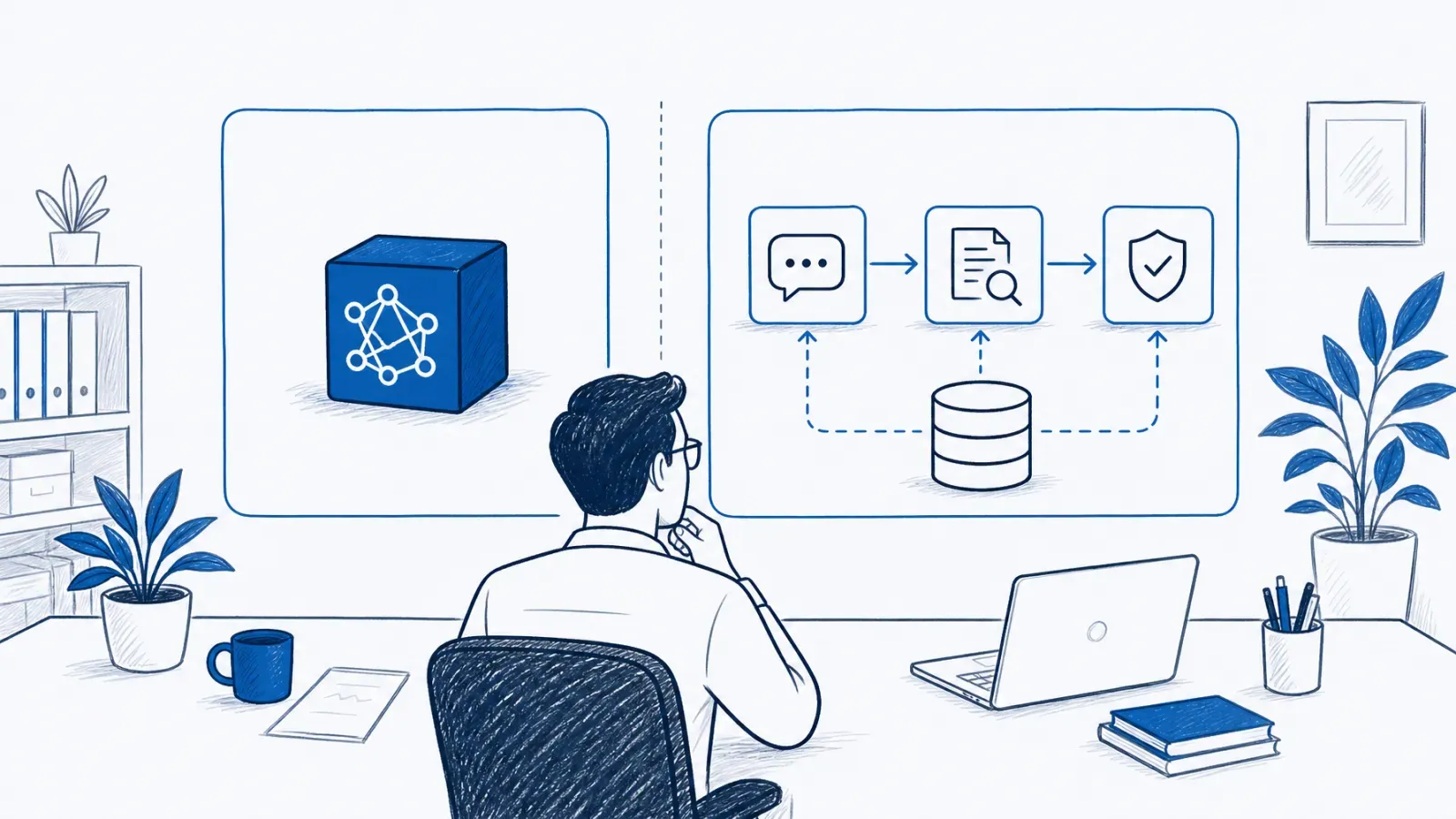
LLM evaluation is repeatable testing of a large language model (LLM) application against task-specific quality, safety, and operational criteria. Enterprise teams combine representative cases, automated checks, and human review, rerun them after every change, and keep monitoring production.
The assistant's answer sounds right. It cites a policy, uses the correct tone, and nobody on the team can say whether that policy is current. That gap between plausible and verified is where many enterprise LLM projects stall.
This guide is for AI product leaders who are formalizing LLM evaluation, and for the engineering, business, and risk colleagues who share the release decision. It explains what to test, how to score it, and what evidence to keep.
You get a practical path from test cases to release evidence, not a tool comparison. Examples use a bank's policy assistant, where one wrong answer carries real cost.
- LLM evaluation is repeatable testing of an LLM application against task-specific quality, safety, and operational criteria, rerun whenever the application changes.
- Model benchmarks describe a model. Application tests describe the whole system, including prompts, retrieval, and controls.
- Match each metric to a failure mode, and report critical-case results next to the overall score.
- Combine rule-based checks, an LLM judge, and expert review, and compare judge scores with expert labels.
- Release testing and production monitoring form one loop: confirmed failures become regression cases.
What is LLM evaluation, and what does it cover?
LLM evaluation is the practice of testing how well an LLM application performs the job it was built for. It checks answers against defined criteria for quality, safety, and cost, using the same cases each time so versions can be compared.
The key distinction is scope. A model benchmark measures the underlying model on public tasks. An LLM application adds prompts, retrieval-augmented generation (RAG), tools, and guardrails, and each one can change the outcome. 2025 application-evaluation research shows that public benchmarks alone do not establish application performance; representative cases and metrics tied to user needs do.
Each test case pairs an input with an expected result: the facts or behavior a good answer must show. The actual result is what the application returned. Evaluation is the comparison between the two.
Which LLM evaluation metrics matter for the task?
Choose metrics by asking how the application can fail. A RAG assistant can give a wrong answer, drift off topic, make a claim its retrieved text does not support, miss the right document, produce unsafe output, or respond too slowly. Each failure maps to a check.
Faithfulness and correctness are different things. An answer can be fully supported by retrieved text and still be wrong if the source itself is outdated. That is why detecting AI hallucinations takes both a source check and a ground-truth check.
| Failure mode | Check |
|---|---|
| Wrong or incomplete answer | Correctness against a reference answer |
| Off-topic reply | Answer relevance |
| Unsupported claim | Faithfulness to retrieved context |
| Missed evidence | Retrieval recall |
| Harmful output | Safety tests |
| Slow or costly reply | Latency and cost per request |
Example: a suite holds 90 routine cases and 10 critical ones. All 90 routine cases pass, and 5 of the 10 critical cases pass. That is 95 of 100 overall, or 95%, but only 50% on critical cases. The numbers are fictional, yet the point holds: an aggregate hides the slice that carries the risk. NIST AI 800-3 (2026) adds that scores are statistical estimates, so small gaps between versions need uncertainty in view.
How should teams score LLM outputs?
Use three scoring methods and match each to the question. Rule-based checks suit anything exact: a required disclosure, a format, a banned phrase. They are fast and repeatable. An LLM judge suits qualities that need reading, such as relevance, and LLM-as-a-judge evaluation only works when a rubric states what a passing answer contains. Human experts decide the risky cases and set the labels everything else is measured against.
Judges are not neutral. NeurIPS research from 2023 found position, verbosity, and self-preference biases. Two checks help. Compare judge scores with expert labels and review each disagreement. In pairwise comparisons, run both answer orders; if the verdict flips with the order, send that case to a person. This investigates bias. It does not remove it.
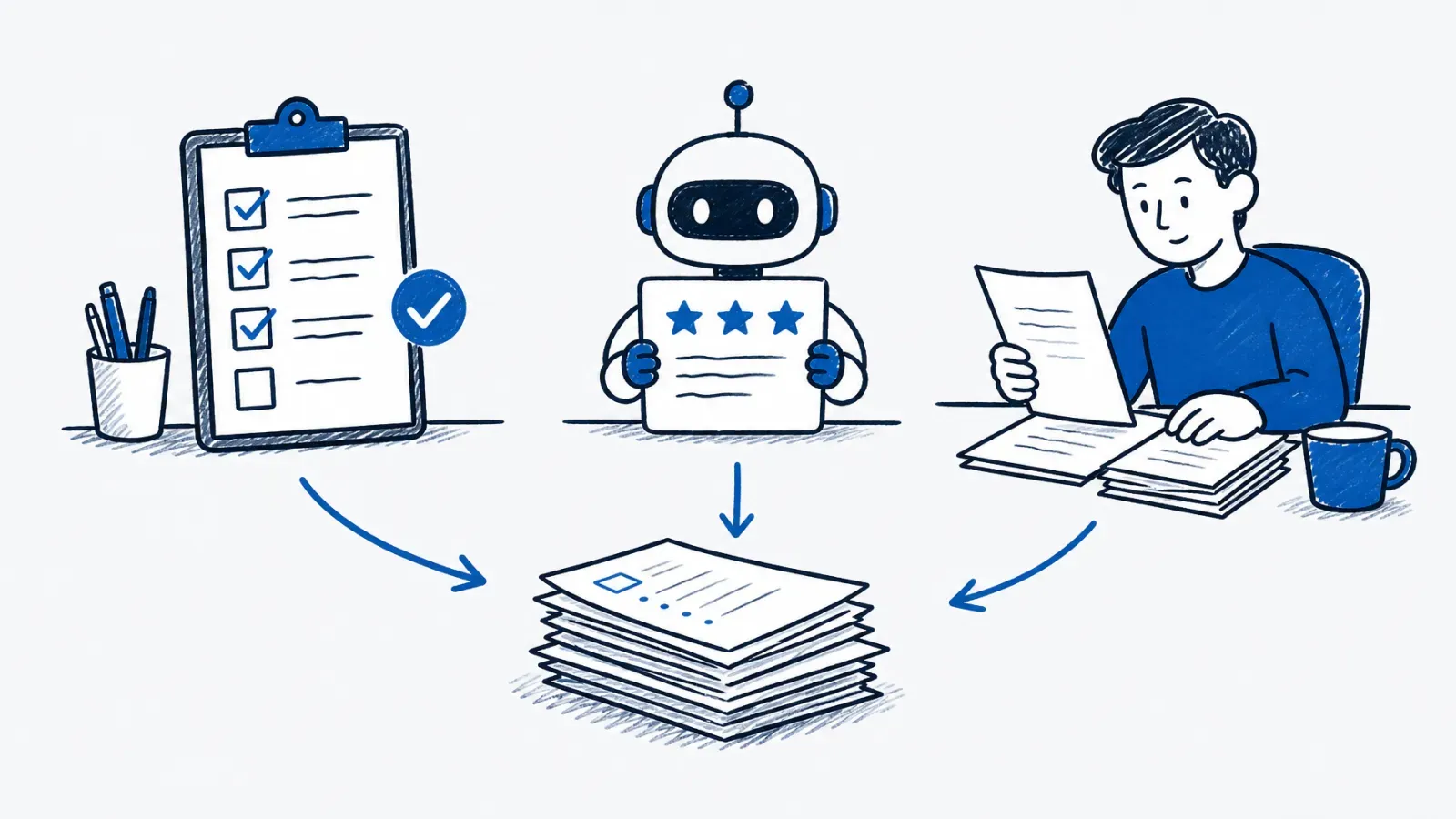
Tooling exists at each layer. Confident AI builds and maintains the open-source DeepEval framework, and Galileo describes its offering as an AI observability and evaluation platform. Both are examples of their categories, not recommendations.
How do you build an enterprise evaluation framework?
Build the framework as a sequence where every result ends in a decision. NIST AI RMF for generative AI is a useful companion for the risk-review side.
- Define the intended task and name the business owner, engineering lead, and risk reviewer.
- Collect representative and high-impact cases, using only permitted data.
- Record the expected behavior and its source for each case.
- Select checks and thresholds. Start from application risks and stakeholder risk tolerance, then use ground-truth data, as threshold-selection research advises.
- Run a baseline on the current version.
- Record results, the owner, and the decision.
Example: a bank's policy assistant (see GenAI governance for banks) is asked what happens when an approved policy source is unavailable. Expected behavior: say the source is unavailable and route to a human, rather than invent a policy. The record holds the source-availability check, the human reviewer, a passed or failed field, and the escalation action. Because an invented policy is a severe failure, the risk owner requires a pass on every run and signs the decision. This is a fictional test case, not a real bank result.
From release testing to production monitoring
Offline evaluation tests a versioned suite before release. Online monitoring watches real traffic after release. The first tells you whether a change is safe to ship. The second shows whether real users are bringing cases your suite missed.
NIST's Generative AI Profile offers voluntary risk-management guidance across the lifecycle. It does not claim that any evaluation passes a regulation, and monitoring does not promise continuous safety. In practice the loop is short:
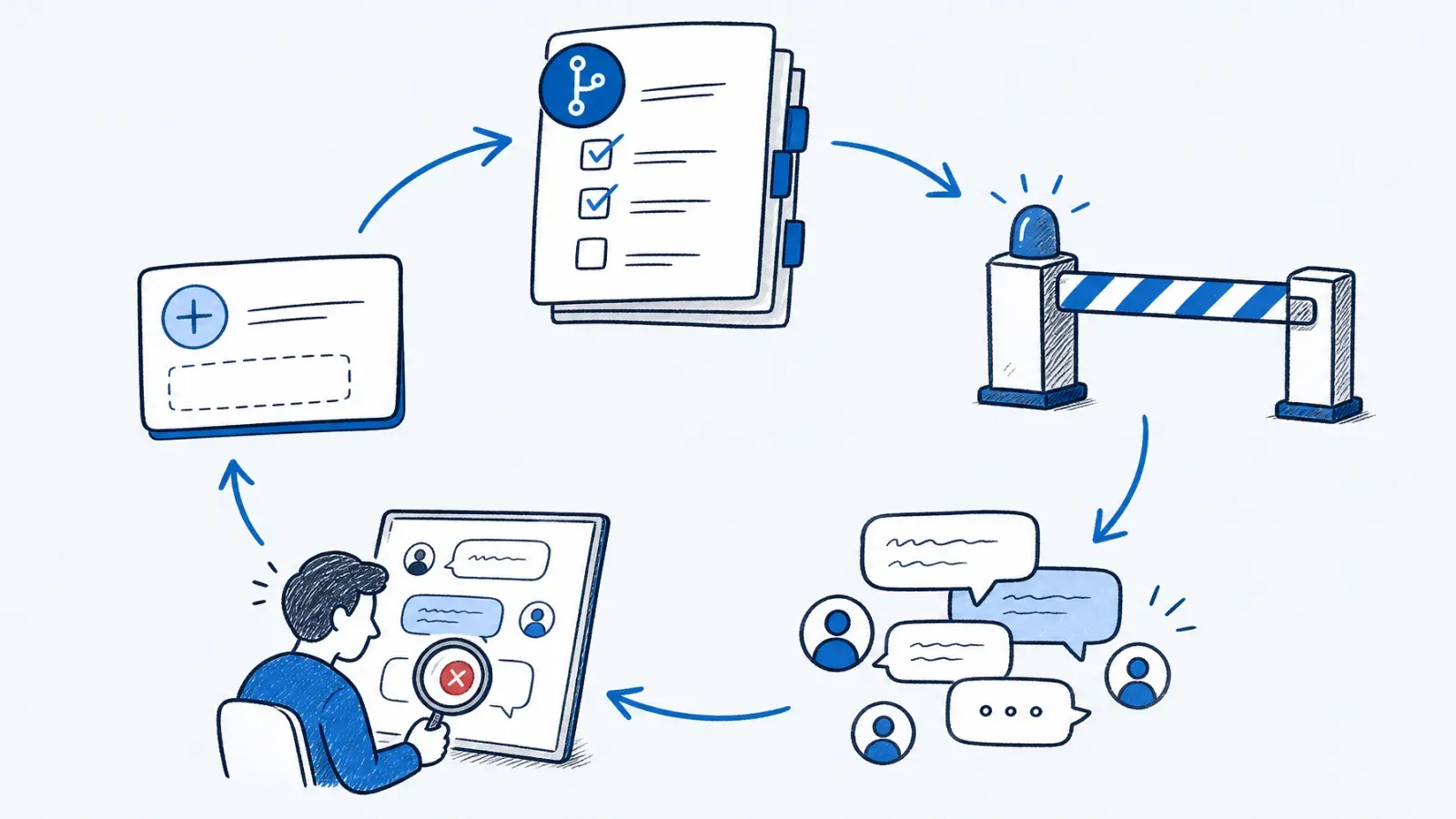
- Rerun the full versioned suite after any prompt, model, or retrieval change.
- Review appropriate samples of production conversations.
- Turn each confirmed failure into a new regression case.
For agents, check tool calls as well as final answers; our piece on evaluating AI agents covers that in depth.
Common LLM evaluation mistakes and tradeoffs
Four mistakes recur, and each has a plain correction. Most trace back to treating a score as proof instead of an estimate.
- One aggregate score. Report critical-case results beside it, as in the 95% versus 50% example.
- Judge scores without expert comparison. Label a sample by hand and review every disagreement.
- Test data that omits risky cases. Add the source-unavailable case and other high-impact ones.
- Assuming evaluation eliminates risk. A score describes the cases tested, and NIST's uncertainty guidance says to read comparisons with that in mind.
Evaluation has a cost. It consumes staff review time, model calls for judges and test runs, and infrastructure usage. Budget for it as recurring work, because every prompt, model, or retrieval change triggers a rerun.
How GenGuardX connects evaluation to enterprise review
The GenGuardX governance platform, from Corridor Platforms, is built for regulated and high-stakes teams that need evaluation evidence to move between business and risk reviewers. GenGuardX supports interactive business-user testing and feedback, so domain experts can try the application and record what they see.

Risk evaluations sit alongside that testing. Results can be shared with predefined roles in an approval workflow, so a reviewer sees the evidence before a release decision. After launch, production monitoring and human annotation queues keep review going on live behavior.
The result is one lifecycle: test, review, approve, monitor, and feed findings back. Financial services and healthcare are among its stated use-case areas.
FAQ
What belongs in a reference answer?
The expected facts or behavior, plus the source needed to judge that case. A reviewer should be able to mark an answer correct or wrong from the reference alone.
Can a fluent answer still fail an evaluation?
Yes. A fluent answer can omit a required fact or contradict the evidence, which is why checks target content, not style.
What should happen when an automated judge disagrees with an expert?
Inspect the case and the rubric, resolve the disagreement, then use the result to improve the judge or the test.
Should a team keep development and evaluation cases separate?
Yes. Keep a held-out set so you can check changes against cases that were not used to tune the application.
Can one passing score establish readiness for every use case?
No. A score describes only the cases and criteria tested, not every possible use of the application.
Who should own an evaluation decision?
Assign the business owner, engineering lead, and risk reviewer explicit responsibilities before the release decision, so each result has an accountable owner.
Choose the next evaluation decision
Start small and start with consequence. Pick one high-impact application task, build a test set that the business owner, engineers, and risk reviewer all own, and expand only when the team can explain what each result changes.
The decision path is short. If a critical case fails, fix the cause and retest before release. If the agreed criteria are met, document the basis for the release decision: the cases, thresholds, and owner. If production shows a new failure, add it to the suite.
Teams that want business testing, risk evaluations, and approval records connected can see how GenGuardX supports GenAI governance by industry. Whatever tooling you use, the next step is the same: write down one task, one failure mode, and who decides.
Resources
Internal resources
- GenAI governance for banks
- GenAI governance by industry
- GenGuardX governance platform
- Detecting AI hallucinations
- LLM-as-a-judge evaluation
- NIST AI RMF for generative AI
- Evaluating AI agents