Every AI agent in your health system, approved with evidence not demos
Patient-facing, clinician-facing, and operations agents symptom routing, ambient documentation, prior-auth, coding, and more. GenGuardX is the shared environment where clinical, operational, risk, and compliance teams validate and monitor any AI agent whoever builds it with the evidence to approve before launch and the monitoring to trust it after.
Before any agent ships, two teams have to say yes
It's rarely one bot, it's a roadmap of patient, clinician, and operations-facing agents, and every one clears the same gate. Clinical and operational leaders need confidence the AI helps patients and staff accurately. Risk, compliance, and legal need evidence it won't cause harm, leak PHI, or create liability. Most pilots stall because neither side has a shared, defensible way to test, decide, and document.
Clinicians and operations leaders own the patient experience, but are often sidelined during technical testing. GGX lets your SMEs interact with the AI, validate it against real scenarios, and build evidence-based confidence to sign off.
Before clinical GenAI goes live, risk and compliance teams need more than a demo they need evidence. GGX stress-tests models against unsafe behavior, tracks how gaps close, and builds an audit trail that holds up to scrutiny.
"In healthcare, confidence can't come from a demo it has to come from evidence."
Where providers put GenGuardX to work
The agents on your roadmap span the whole care journey: patient-facing, clinician-facing, and operations. For each one, GGX defines the risks that matter, runs standardized evaluations, and produces the evidence to approve and monitor.
Patient routing & symptom protocols
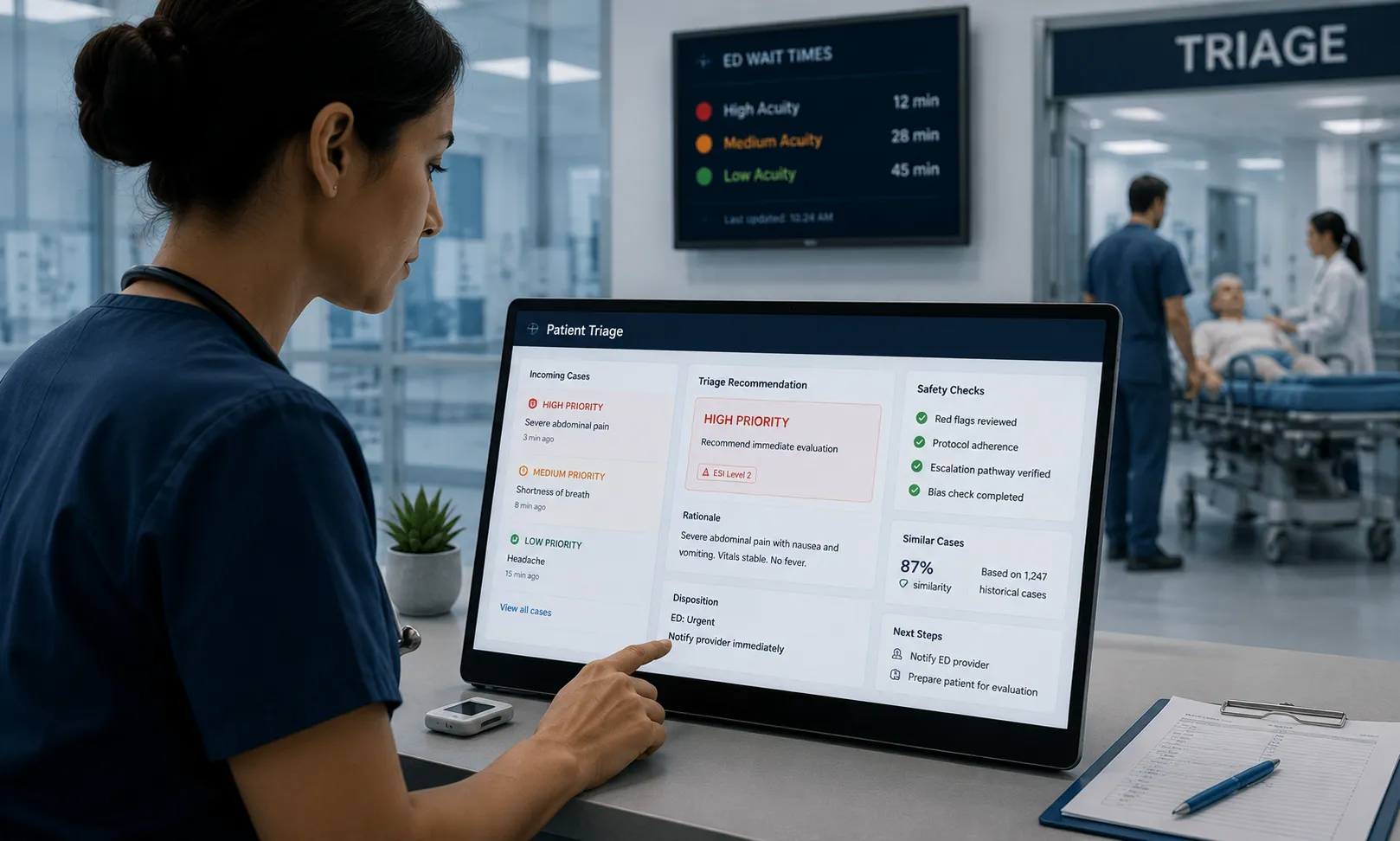
Patient-routing IVR and chat that route patients by acuity, follow clinical protocols, and escalate emergencies safely without over- or under-prioritizing.
EHR integration & summarization
Summarize charts, prior history, and visit notes, and surface relevant context to clinicians grounded in the record, never invented.
Call-center & front-desk operations
Automate scheduling, FAQs, prescription refills, and prior-auth status deflecting call volume while keeping answers accurate and on-policy.
Lab result analysis & explanation
Interpret and flag results, route abnormal values to the right team, and draft patient-friendly explanations that stay within clinical bounds.
Ambient & automated documentation
Turn encounters into structured notes and reduce clinician documentation burden with faithful capture and no fabricated findings.
ICD-10 & medical coding
Suggest accurate diagnosis and procedure codes from documentation to reduce denials and rework with traceable justification for every code.
Turn clinical AI review into a repeatable workflow
The same four steps clear the gate for any agent, whether patient-, clinician-, or operations-facing. Identify the risks that matter, measure them with standardized evaluations, mitigate the gaps, and monitor after launch, with evidence at every step.
Map clinical risks
Select use-case risks: clinical accuracy, groundedness to the EHR, PHI leakage, hallucination, demographic bias, unsafe escalation, prompt injection.
Run standardized evals
Repeatable tests against curated clinical datasets, expected outputs, protocols, and thresholds, not one-off scripts or vibes.
Close gaps & retest
Apply guardrails, escalation logic, retrieval grounding, or prompt changes, then prove the gap is actually closed.
Watch for drift
Turn production traces into alerts, evidence, and new test cases as inputs, models, and content change after go-live.
Every clinician reaction becomes ground truth
Each flag, rating, and annotation from a clinical SME becomes reusable, structured ground truth, supporting objective measurement, faster iteration, monitoring, and future evaluation sets. SME time is scarce; GGX captures it once and reuses it across the whole AI lifecycle.
The risks GenGuardX tests for in clinical AI
Pre-built, healthcare-specific evaluation categories, plus your own custom risks, thresholds, and datasets.
Clinical accuracy & groundedness
Answers stay faithful to the record, the protocol, and the evidence not invented.
PHI & HIPAA data leakage
Detect exposure of protected health information and privacy violations.
Hallucination & fabrication
Catch fabricated findings, citations, and clinical detail before patients see them.
Unsafe escalation & missed acuity
Verify emergencies escalate and high-acuity cases are never downplayed.
Bias across demographics
Test for disparate performance across patient populations and groups.
Prompt injection & jailbreak
Stress-test against manipulation, data exfiltration, and out-of-scope use.
One shared environment, built for clinical AI
The same modules your clinical, risk, and compliance teams use to test, approve, and monitor any AI agent (patient-, clinician-, or operations-facing), connected to your stack and your evidence.
Pipeline Builder
Compose multi-agent systems: an orchestrator routing to specialized sub-agents, each with its own model, tools, and grounding. Then compare whole configurations to find the safest setup for each clinical use case.
Human Integrated Testing
Clinical SMEs run real patient scenarios against the AI, flag issues, and rate responses: human judgment combined with automated scale and a closed feedback loop.
Risk dashboards & curated reports
Starter clinical tests and customizable reports for accuracy, groundedness, PHI, toxicity, and bias: versioned, reusable, and ready for audit.
Trust Score
A single, defensible readiness measure, rolled up from objective sub-metrics and tracked version over version, so progress and approval are provable.
Governed Workbench
Role-based access, lineage, versioning, and approval workflows so clinical, risk, and compliance teams work from one shared, auditable record.
Connectivity
Out-of-the-box LLM connectors plus API hooks into your EHR and clinical systems, grounded to the record, for pre- and post-production monitoring.
How a leading US health system shipped safely
Two very different agents, one operational and one patient-facing, with very different risk profiles. Both reached production with the same method and real evidence, not guesswork. Details anonymized at the customer's request.

Call-center operations bot
The challenge: a high-volume assistant for scheduling, FAQs, and call routing. Clinical risk was low, so the real bottleneck was confidence and sign-off, not the model. What GGX did: ran standardized accuracy, tone, and policy evaluations, captured SME feedback in one place, and produced approval evidence fast enough to launch in about a month.
"The evaluations gave our operations and risk leads one objective view. Sign-off went from stalled to a few weeks."Director, Digital Operations, at a leading US health system
Patient assessment bot
The challenge: a patient-facing assessment assistant with direct clinical-safety stakes. It had been considered "ready" for months but could not clear risk and legal. What GGX did: mapped the risks with clinicians, ran exhaustive testing across protocol adherence, safe escalation, groundedness, and bias, and iterated with SME validation until every threshold was met and the evidence held up to review.
"We finally had evidence the committee accepted, not a demo. That was the difference between stalled and shipped."VP, Clinical Informatics, at a leading US health system
Built to clear your security and compliance review
Clinical AI doesn't ship until your CISO, privacy, and legal teams sign off too. GenGuardX is built to pass that review: your PHI stays protected, your deployment stays in your control, and every action is logged and auditable.
Your PHI stays yours
We never train models on your data. Everything is encrypted in transit and at rest, with configurable retention and de-identification. Your protected health information never leaves your control.
Certified & compliant
SOC 2 Type II and HIPAA-aligned, with a Business Associate Agreement available on request.
Deploy anywhere
Secure SaaS, your own VPC, or fully on-prem, with data-residency options.
Model-agnostic
OpenAI, Google, Anthropic, or your own private and self-hosted LLMs.
Access & audit
SSO/SAML, role-based access, and immutable audit logs across every test, approval, and version.
Enterprise cloud
Built on Google Cloud, Azure, and AWS, with the isolation and reliability enterprise health systems expect.